
Gwinear Road – A Brief History

Map of West Country Main Line. Image Oakwood Press
Built in 1852 on the Paddington to Penzance GWR main line route, Gwinear Road was a rural junction station situated in the south west of England, Cornwall.
Located 3 miles by road from the small village of Gwinear, the station was chosen as the junction point for the branch line to Helston. The Helston branch line, which opened in 1887, was originally intended to extend to the Lizard but instead the terminus was at Helston, with a bus service linking to the Lizard.
Gwinear Road consisted of up and down platforms for mainline services and an additional platform face for the branch line. It had a fairly complex track layout, until its closure in 1965, with sidings on both sides of the main running lines including;
- two dead-end sidings on the up-side, used mainly for the loading of potatoes, broccoli and other agricultural traffic.
- extensive array of sidings (8) on the down-side providing storage and re-marshalling facilities
- long up and down refuge lines on each side of the down main line, used to berth slow-moving freight trains
- lines doubled in both directions
Other minor details included; cattle pens, loading docks, weigh-house, a station masters house and an awkward angled level crossing that, at this point in time, boasted the longest crossing gates in Cornwall!
Period, 1939-1945
The period to be modelled is that of between 1939-1945. With the outbreak of the WWII, this was one of the busiest times for the junction, serving as the changing point for scores of youthful ‘evacuees’ from London and large numbers of service men to and from aerodromes and other military establishments via the Helston branch line to the Lizard Peninsula.
As well as 6 trains per day arriving and departing on the branch line there was also an armoured train that ran along the line during this period.
It consisted of an ex-Great Eastern ‘F4’ class 2-4-2T, flanked by two low sided general purpose wagon and two LMS steel 20 ton coal wagons. Protected by quarter inch steel plate and equipped with rifles, machine guns and naval six-pounders and when on patrol carrying a crew of 26.Oakwood Press
A challenging mini-project build of its own!
Together with the above and the regular main line passenger and freight services to and from Penzance, including the stopping ‘Riviera Express‘ and an abundance of broccoli brought up from the branch line, modeling this period in time will make for an interesting overall layout.
Track Layout
The track layout for Gwinear Road changed quite a lot during its active time. Old signal boxes removed, new ones added, lines doubled in both directions and various loops / sidings add here and there.
To minimize space and increase overall operational movements the track layout as it was during the early 20th century (1908), was decided upon.
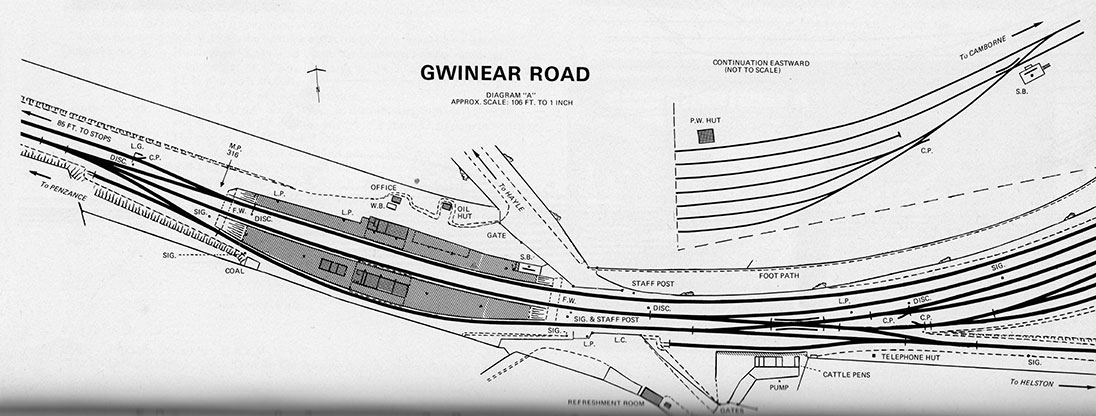
Gwinear Road Track Plan 1908 Image A Historical Survey of Selected GWR Stations
Notably keeping the single down line towards Penzance, instead of double track, 5 instead of 8 sidings within the marshalling yard, and omitting the refuge up loop which was introduced in 1925.
Information and images sourced from the following Resources.